
Ledger
Oopbuy costs, exchange rate and shipping, measured from the intake
Zero service fee, a fixed conversion divisor in every quote, and shipping priced on the weight recorded at the scale.
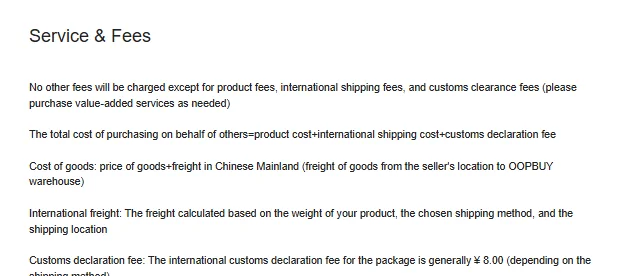
Service fee and the full cost breakdown
Oopbuy's Service and Fees page states a zero agent service fee. What you actually pay: product cost (item price plus the seller's domestic freight to Xiamen), then international shipping, plus a customs declaration fee of generally 8 RMB per parcel depending on the route. Warehouse extras are optional.
The intake-stage extras, in one place: Detailed Photo 1 RMB each; Parcel Photo 5 RMB per parcel; Rehearsal Packing 20 RMB per parcel; storage extension 10 RMB or CNY per period, with the conflicting limits described on the Requests page. Fine Photography and customised warehousing are priced on request.
The user registration agreement still contains a clause setting an 8% platform fee on goods and shipping. Every customer-facing page says zero, and the clause reads as leftover template text. It is noted here so you are not surprised if you read the agreement.
A worked example keeps the parts in proportion. An item listed at 89 yuan with 8 yuan of domestic freight costs 97 yuan in the first payment. If the intake records 386 g and you send it alone on a 50 g step route, the second payment is that route's price for 400 g plus the declaration fee of generally 8 yuan. Detail photos, if you ask for two, add 2 yuan. Nothing else is charged by the agent.
A fixed divisor in every dollar quote
Oopbuy's estimator prints every route twice, in yuan and in dollars. On 10 October 2026 the US 1 kg table showed 200.72 CNY against 33.59 USD for the cheapest route, a ratio of 5.9756, and the same divisor reproduced every other route in that response.
A fixed divisor is a currency conversion with a margin built in, whatever the interbank rate is that day. A dated comparison of displayed currency amounts does not establish the full funding cost for every payment method. Check what is credited and what you actually pay before comparing agents.
Top-ups add their own cost. The Top-up page lists PayPal at 4.5% plus 0.30 USD and converts to USD; an FAQ still says "approximately 3.7% plus 0.3 USD". Wise accepts USD, GBP, EUR, NZD and AUD.
Shipping routes and how the intake weight is priced
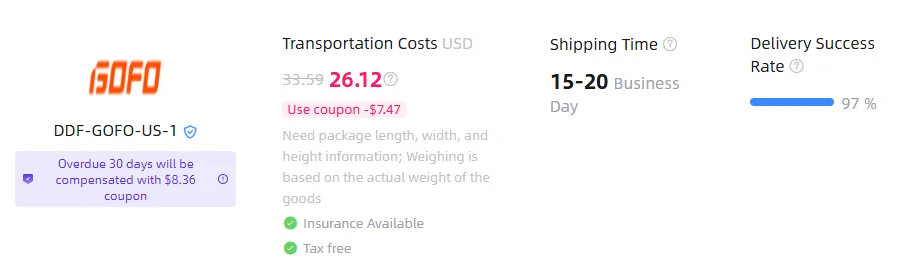
Asked for 1 kg of common goods to the United States, the public estimator returned 23 routes on 10 October 2026: postal lines, international express and dedicated small-packet lines. The cheapest, DDF-GOFO-US-1, quoted 200.72 CNY for 15 to 20 working days; the fastest listed, ZD-UPS-US-HK, quoted 554.32 CNY for 7 to 12.
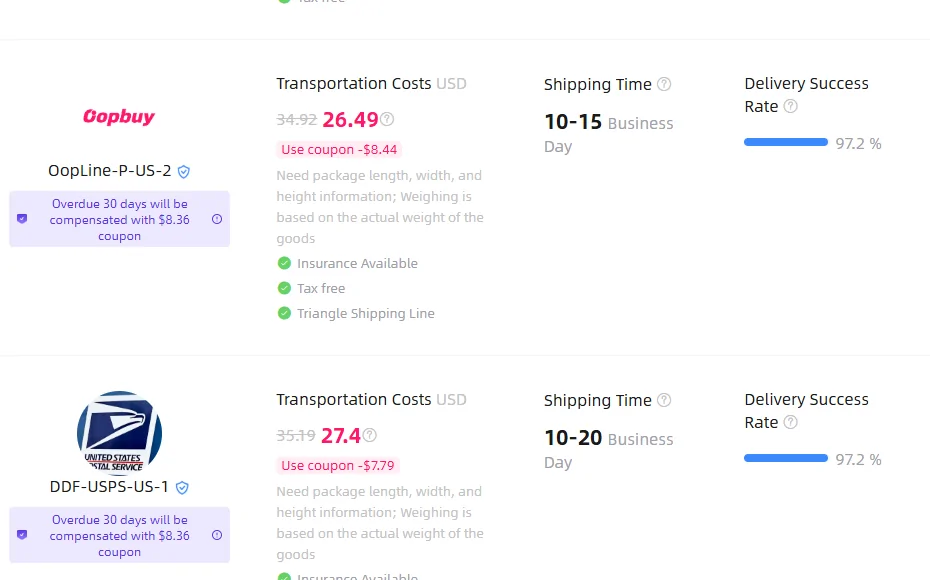
Every route row carries its own transit window, a delivered-share figure, an insurance flag, a tax label and the weight and size ceiling it will accept. Two DDP routes, HF-EUB-US-1 and HP-EMS-US-1, carried a 50 CNY clearance fee in that table. The same 1 kg common-goods query returned 16 routes for the United Kingdom and 15 for Germany; routes that do not accept common goods are not listed in that count.
Routes and prices change often. Run the estimator with your recorded intake weight and dimensions, and treat the figures here as a dated example, not a quote.
Delivery time: three published versions
Oopbuy describes delivery time in three different ways. The Delivery Time page says about 15 to 30 days depending on the destination. An FAQ says goods can arrive within 7 working days at the earliest. The estimator gives each route its own working-day band.
The estimator is the only version tied to a specific route, so it is the one to plan with. Remember that none of these clocks start at intake: they start when your parcel leaves the warehouse after you submit and pay for it.
Insurance and the claim deadlines
Loss and damage are compensated according to each route's own compensation standard, through after-sales or customer service. The Insurance and Compensation page sets the deadline: no claim after 7 days from signed delivery, or 45 days from dispatch.
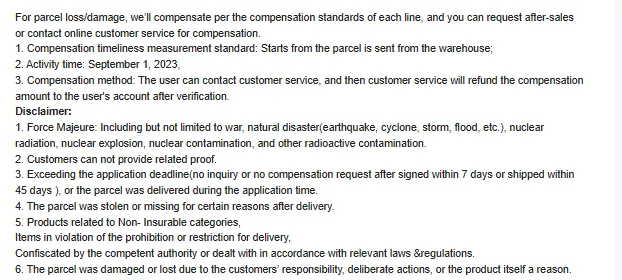
The exclusions are listed: force majeure, no proof, theft after delivery, non-insurable categories, prohibited or confiscated items, and the customer's own fault. Fragile goods are covered for loss but not for damage. The evidence you will need for a claim, the weight and the condition before dispatch, is created at intake and in the optional parcel photo.
A complete budget has two checkpoints
Before buying, list goods, domestic delivery and the actual funding/conversion cost. Estimate international freight using the destination, contents and probable packed dimensions. Do not treat a coupon bundle as cash or add an exchange margin again to an already converted amount.
Before dispatch, replace the estimate with the measured parcel, selected line and optional services. Compare chargeable weight and rounding, not only the scale reading. Keep destination charges separate and check the line’s conditions rather than reading a tax label as a guarantee for every case.
Box removal and compression can reduce volume but can also remove protection or make a return harder. Extra photographs and rehearsal should answer a concrete uncertainty. Compare the complete basket and service level when choosing another route or agent.
From packed parcel to receipt
Save the estimated and final freight records together. A change in dimensions, line or extras may explain a supplemental charge; ask for the relevant calculation when it does not. Track pickup and subsequent scans rather than assuming a generated waybill is already moving.
At delivery, check the packaging and contents, keep labels and document any problem promptly. Use the parcel’s support conversation with the tracking event and concise evidence. Review that parcel’s protection, exclusions and claim deadline; storage and item-return rules are separate.